
Weathering Solutions
Depth Weathering Solution (DWS)
The Depth Weathering Solution (DWS) addresses near-surface velocity variations directly within the depth imaging workflow. By incorporating a detailed near-surface velocity model, DWS helps improve the accuracy and continuity of seismic imaging in complex land environments.
Near-surface challenges in depth imaging
We are constantly seeking opportunities to improve seismic imaging in difficult terrain. For depth imaging, we discovered that we need a different approach to resolving the problems of near-surface weathering. Prestack Depth Migration (PSDM) creates an opportunity to more accurately resolve imaging issues caused by near-surface velocity variation across all geologic settings.

The near surface as a limiting factor
The near surface is the lens through which we image subsurface structures with seismic data. Improved accuracy of the near-surface weathering correction results in improved accuracy of seismic imaging.
Depth Weathering Solution (DWS) approach

Comparison: Time-based vs depth-based weathering correction
Depth image with time-processing statics
Depth image with time-processing statics applied. This is the standard workflow for correcting for near-surface weathering effects. Since the input data includes weathering statics, the weathering velocities are not included in the velocity model (above).
Depth image after applying DWS workflow
Depth image after applying the DWS workflow. The velocity model includes first-arrival tomography velocities (above) and the input data only has depth-imaging reflection statics calculated using model moveout (MMO)
From time-based statics to depth-based correction
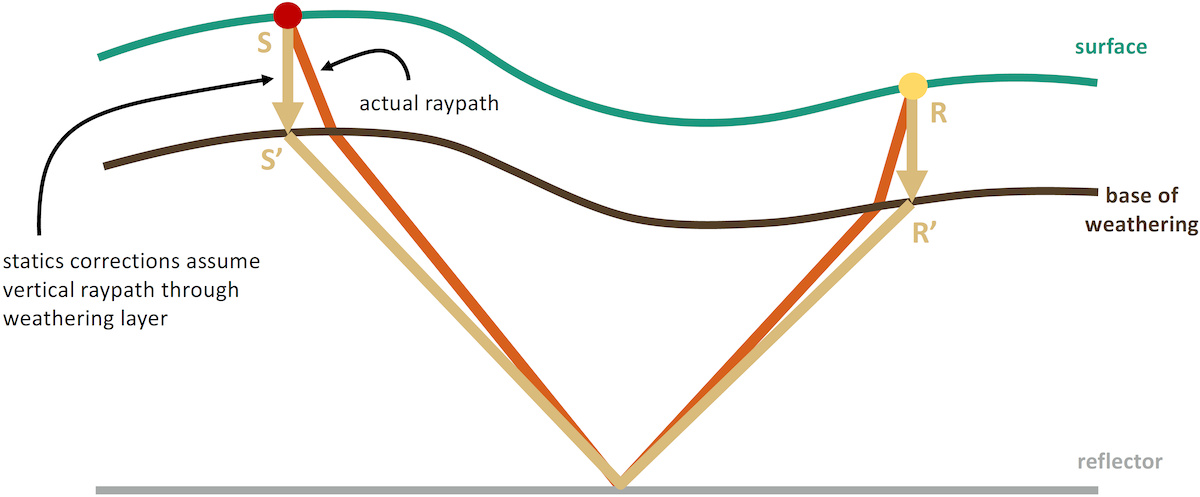
In time processing, after we apply the initial weathering correction in the form of refraction statics, the reflection statics correct for surface-consistent time delays left behind by the first-arrival tomography statics. This gives us a complete time weathering solution (TWS). These reflection statics are intrinsically coupled to the time-processing moveout velocities and refraction statics.
Model-based Normal Moveout (MMO)
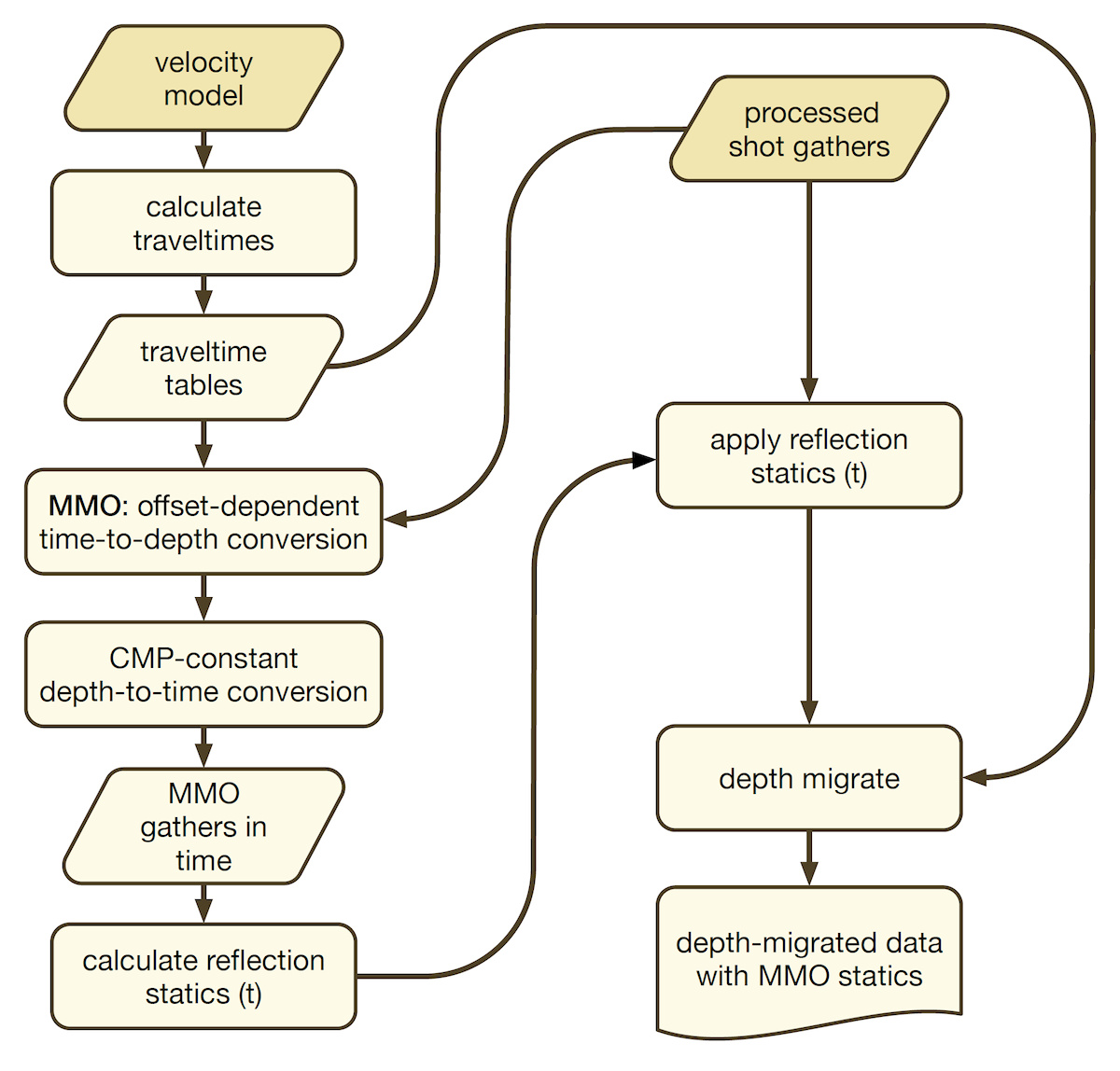
We developed a method to calculate residual reflection statics that is coupled to the depth-migration weathering correction. We achieve this through a model-based normal moveout correction that we call MMO. Basically, MMO is NMO that uses source and receiver traveltimes instead of the NMO equation.
A depth-consistent weathering solution
MMO completes our DWS, which is independent of the TWS and its inherent time-processing assumptions.