
Advanced Algoritms
Full Waveform Inversion (FWI)
Wave-equation-based velocity model updating for complex land seismic data
From reverse time migration (RTM) to full waveform inversion (FWI)
Our land-focused FWI services combine wave-equation-based inversion with interpretive knowledge to update velocity models for complex seismic environments. Full Waveform Inversion (FWI) has emerged from wave-equation-based imaging methods, building on the same physical principles that enabled Reverse Time Migration (RTM) to succeed in complex geological settings.As demonstrated by RTM, algorithms that solve the full two-way wave equation can accurately handle complex geology. FWI leverages this same wave-equation fidelity, but moves beyond imaging to iteratively updating the velocity model. Our FWI workflow leverages our interpretive knowledge of the subsurface structure, our interpretive velocity models, and the accuracy of the data-driven inversion.
Challenges in applying FWI to complex-structure land data
Acquisition and data limitations
The application of FWI to complex-structure land data presents additional challenges beyond those encountered in marine environments. Complex land data are often characterized by the following:
- Sparse and irregular acquisition
- Strong near-surface heterogeneity
- Rough topography
- Low signal-to-noise ratios
- Uncertainty in both the starting velocity model and source signature
Sensitivity and limitations
These factors make land FWI particularly sensitive to source estimation, cycle skipping, modeling errors, and amplitude inconsistencies, limiting the effect of FWI in these settings.
FWI developed for complex structural environments
We have partnered with DevitoCodes to develop an FWI specific to these challenges. Our FWI workflow relies on our 20+ years experience processing these seismic surveys, including:
Integrated Velocity Model Building Inputs
- Structural Interpretive Velocity Model
- Depth Weathering Solution (DWS)
- Proprietary wavelet matching
- Immersed and Dampening surface boundary conditions
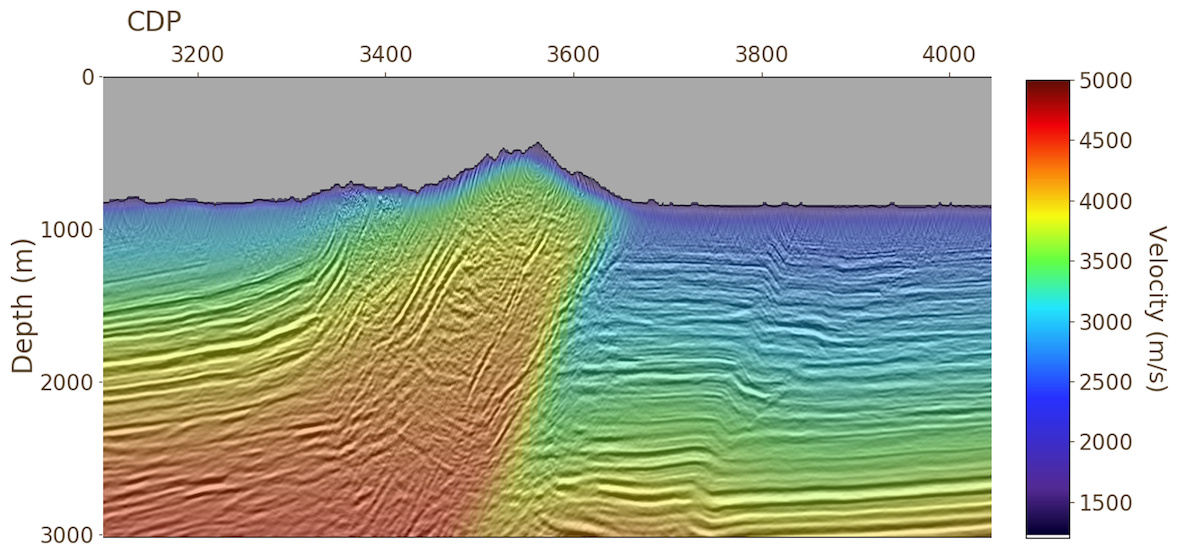
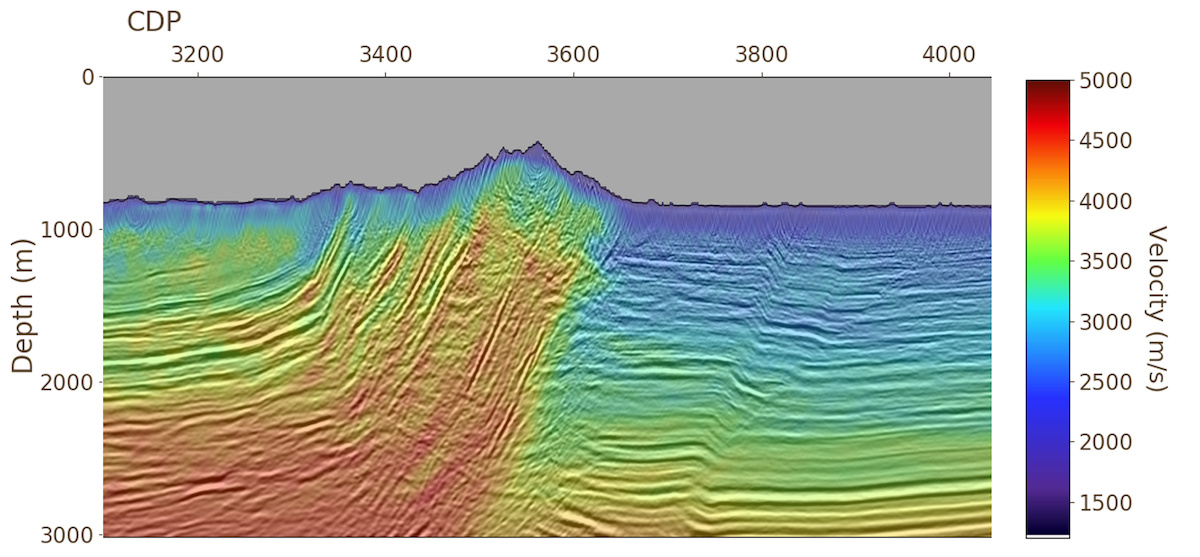
Comparison of initial model vs 10 iterations of FWI. Note the improvement in reflector continuity around the major thrust fault at CDP 3600. The subtle changes in velocity around the small throw faults at CDP 3800 add clarity to the image.
Advanced computational framework (DevitoCodes)
DevitoCodes has enabled our FWI to be computationally efficient and flexible, allowing rapid prototyping of advanced physics, higher-order discretizations, and scalable implementations. We are able to easily test different wave equations, imaging conditions, misfit functions, and optimizers to best update the velocity models.