Velocity Model Building Solutions
3D model building for 2D depth imaging
Ensuring structural consistency across interconnected 2D seismic lines through integrated 3D velocity model construction.
The Challenge: Line-to-Line Velocity Inconsistency
When building velocity models for multiple 2D seismic lines across a block, the process requires considerable diligence to ensure consistency from line to line. If velocity models are developed independently without block-wide control, subtle inconsistencies can propagate into the depth domain.
These inconsistencies may generate artificial structural variations — creating false highs or lows that do not reflect true subsurface geology but instead arise from differences in model parameterization between adjacent lines.
The challenge becomes particularly critical when working with interconnected 2D datasets. Even when structural complexity is moderate to low, lateral velocity variations must be handled in a geologically coherent manner to avoid introducing non-geologic artifacts.
In such settings, constructing independent 2D velocity models is often inefficient and geologically unstable at the block scale. A strategy that enforces structural and velocity consistency across the entire project area becomes necessary.
Our Solution: 3D Velocity Modeling for Block-Wide Consistency
To ensure structural and velocity consistency across multiple interconnected 2D lines, we construct a unified 3D velocity model from which consistent 2D models are extracted.
Rather than building independent line-by-line velocity models, the workflow integrates all 2D seismic lines into a common 3D framework. This approach enforces lateral continuity and geological coherence across the entire project area.
Integrating 2D Lines into a 3D Interpretation Framework
All 2D seismic lines are loaded into a 3D grid within the interpretation environment (e.g., opendTect).
Using the structural interpretation from each 2D line, we construct continuous 3D surfaces across the block. These surfaces form the geometric backbone of the velocity model.
This step ensures that structural boundaries are regionally consistent and not interpreted in isolation.
Building the Interpretive 3D Velocity Model
Following the same principles applied in full 3D model building, the velocity model is constructed interpretively within the 3D framework.
The model follows the geometry of the 3D structural horizons, ensuring that velocity variations honor geological structure. Both velocity parameters and anisotropic properties are incorporated where required.
Because the model is built in 3D space, lateral velocity continuity is naturally enforced.
Extraction of Consistent 2D Velocity Models
Once the 3D velocity model is established, individual 2D velocity models are extracted for each seismic line.
Each extracted model includes:
- Velocity fields
- Anisotropy parameters (when applicable)
These models are then used to depth migrate each 2D line independently, but under a regionally consistent velocity framework.
Iterative Depth Refinement
After depth migration, the resulting 2D lines are reloaded into the 3D interpretation environment.
The structural model is refined in depth, and the velocity model is updated iteratively following the established model-building workflow.
This closed-loop process continues until structural consistency and geological plausibility are achieved across the entire block.
Technical Workflow Overview (Visual-Centric Section)
Load 2D lines into 3D grid
Build 3D structural surfaces
Construct interpretive 3D velocity model
Extract 2D velocity models (velocity + anisotropy)
Depth migrate each 2D line
Reload in 3D space for structural refinement
Iterate model updates
Case History Example: 3D Interpretation of Interconnected 2D Lines (EAGE 2015)
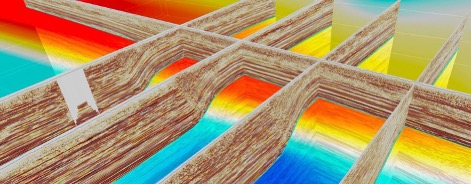
An example of this workflow was presented at EAGE 2015. The case demonstrates the application of 3D model building for a project composed of multiple interconnected 2D seismic lines.
Figure 5 shows a 3D visualization of one of the interpreted velocity boundaries within the 3D volume during the model-interpretation process.
Although the input dataset consisted of 2D seismic lines, the interpretation and velocity modeling were performed within a unified 3D framework to ensure structural continuity across the block.