
Advanced Algoritms
Reverse-Time Migration (RTM)
Reverse Time Migration (RTM) for land data provides a wave-equation-based imaging approach for complex structural environments where conventional migration methods can be limited. RTM accurately handles complex wave propagation, steep dips, and strong lateral velocity variations, making it particularly valuable for challenging onshore geology.
Limitations of Kirchhoff migration in complex geology
In areas characterized by strong vertical or lateral velocity contrasts, conventional Kirchhoff migration often breaks down, producing imaging artefacts or poor imaging. Reverse Time Migration (RTM) addresses these challenges by directly solving the full two-way wave equation. With an accurate velocity model, RTM can correctly image strong lateral velocity variations, overturned reflectors, and steeply dipping events that are beyond the capabilities of Kirchhoff-based methods.
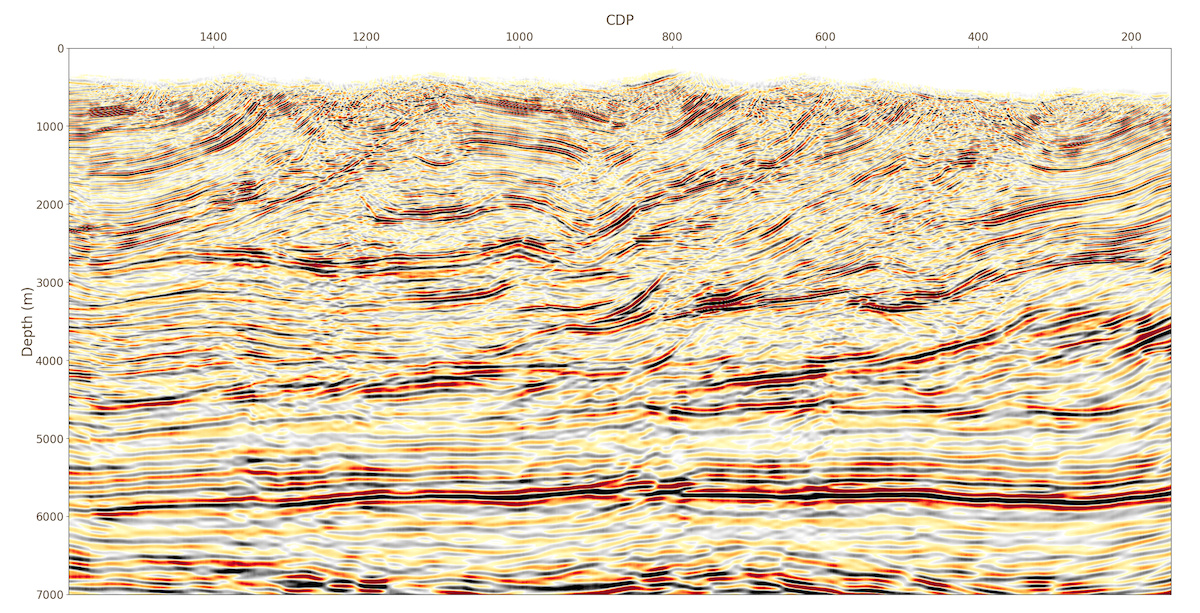
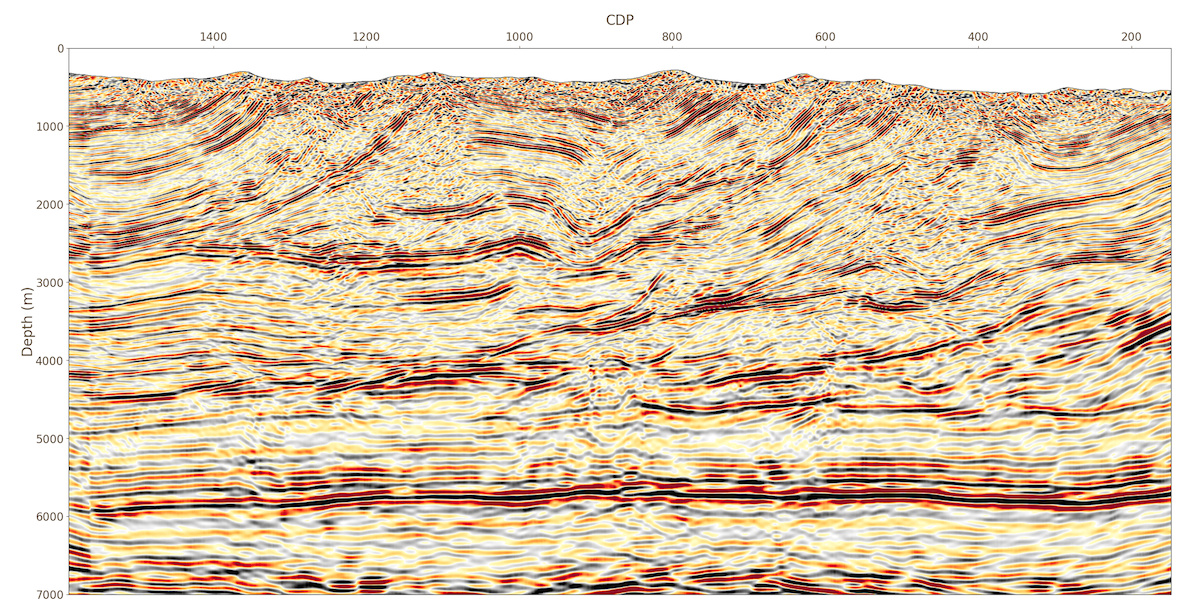
Comparison between Kirchhoff and RTM using the same velocity model. Note the improvements in imaging in areas of complex geology and steep dips
When RTM makes the difference
RTM provides a significant improvement in imaging when three key criteria are met:
- The presence of strong and dipping velocity inversions, typically exceeding 25%, such as those associated with major overthrust systems.
- Adequate spatial wavefield sampling to ensure numerical stability and accurate propagation.
- A highly constrained velocity model, as RTM is more sensitive to velocity errors than Kirchhoff prestack depth migration (PSDM).
Under these conditions, an algorithm that offers a more complete solution to the wave equation can successfully resolve imaging problems that otherwise persist. We have developed our RTM specific to the challenges of complex structure land data.
Challenges in applying RTM to complex structure land data
Rough topography
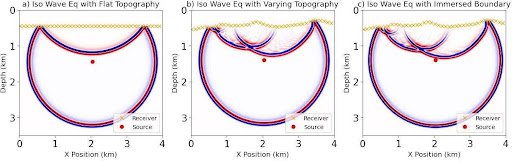
Rapid changes in topography introduce significant noise, irregular scattering, and coupling issues, degrading data quality. Traditional finite-difference schemes struggle to handle such variability, leading to unrealistic wave propagation patterns and diminished imaging reliability.
Anisotropic complexity
Foothills geology requires complex anisotropic wave equations, such as tilted transversely isotropic (TTI) formulations, to accurately model wave propagation.
Uncertain velocity model
The largest limitation to RTM is the velocity model inaccuracy. The benefits of RTM will not be realized if the velocity model does not have the accuracy to model these complexities correctly.
Innovative RTM approach using immersed boundaries
We have developed an RTM that addresses these longstanding challenges through a novel implementation tailored for foothill environments. Key innovations include:
Immersed boundary techniques for rough topography
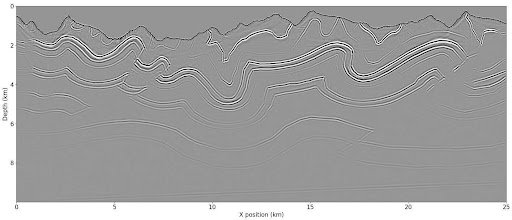
By integrating immersed boundary methods into the RTM framework, we accurately model topographic effects on wave propagation, reducing noise and preserving the integrity of seismic signals (Caunt et al. 2024).
Stable and accurate TTI formulations
We develop robust computational stencils to mitigate instability in TTI equations, ensuring reliable imaging in heterogeneous anisotropic environments.
Leveraging the iterative model-building workflow
Imaging improvements of RTM create opportunities to optimize the velocity model with revised structural interpretation.
The velocity model for RTM is built during the Kirchhoff PSDM workflow, with additional RTM iterations. Kirchhoff PSDM is, therefore, a prerequisite for RTM. If the data in this block looks like strong candidates for RTM, we suggest testing the suitability of RTM on a 2D dataset.