
Velocity Model Building Solutions
Geologically Constrained Model Building
Geologically constrained velocity modeling integrates seismic interpretation, structural geology, and velocity information to build models that are consistent with complex subsurface structure.
An interpretive approach to velocity model building
We primarily use a Kirchhoff algorithm because it allows us to calculate anisotropic traveltimes from exact source and receiver elevations in rough terrain. Taking an interpretive approach to model building, the fast turnaround of our highly optimized anisotropic depth migration algorithm allows us to experiment with a variety of velocity-model interpretations in our quest for an optimum imaging solution.
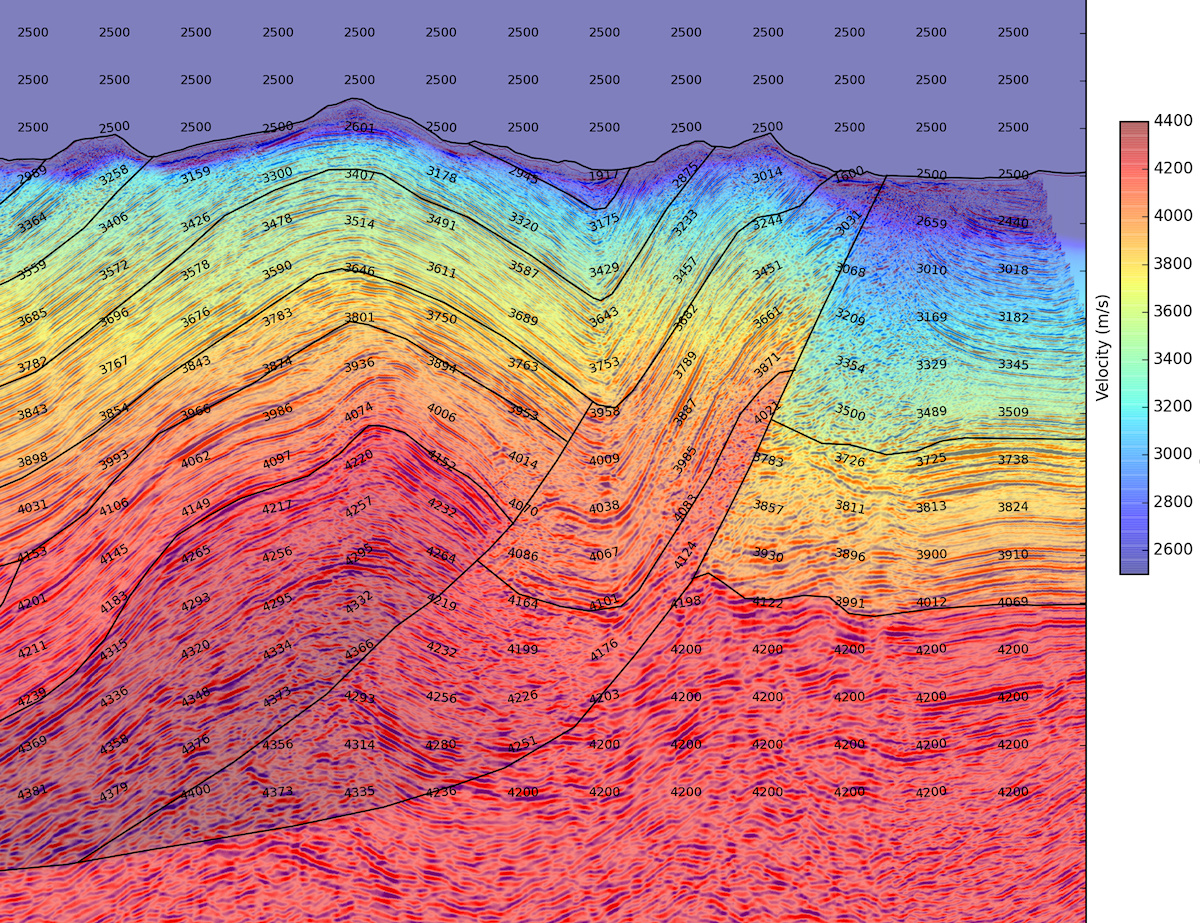

Integration of geological knowledge and interpretation
Building these velocity models involves close collaboration with the interpretation team. We have software to efficiently build the models and migration algorithms that produce sharp images, but it is the local domain-knowledge that allows us to converge to a geologically accurate velocity model. We further evaluate the accuracy of the model using well calibration and seismic diagnostics such as image gather flatness, reflection continuity and fault sharpness.
Kirchhoff Anisotropic (TTI) Depth Migration Workflow
Final depth imaging and residual analysis
- Final prestack anisotropic depth migration
- Residual velocity analysis (NMO focussing) to improve the final image
- Stack migrated and focussed gathers; apply filter, scaling, cosmetics as necessary
Iterative velocity model updating
Update velocity model and re-migrate through the required number of iterations to optimize the velocity model:
- Maximize flatness of image gathers
- Minimize depth error between seismic reflectors and well tops
Initial velocity model from interpretation
In collaboration with interpreter, define initial velocity model from interpretation of prestack-time-migrated section
Incorporation of anisotropic parameters
Incorporate anisotropic parameters epsilon and delta
Use dip meter information from logs and geological input from interpreter to accurately define the dip field for TTI anisotropy correction