
Depth Imaging Services
Integrated Data-Driven Approaches
Advanced computational methods for velocity model enhancement in structured land environments.
Data-driven velocity model building in structured land environments is challenging because seismic data is typically sparsely sampled and has a poor signal-to-noise ratio. For many projects, interpretive velocity modeling provides the most stable and accurate velocity model. For datasets where data quality supports these methods, we supplement this foundation with advanced data-driven approaches.
Data Quality as the Decision Driver
Structured land data often presents sparse sampling and low signal-to-noise ratios. Under these conditions, purely automated velocity model building techniques may not converge to reliable results.
For this reason, interpretive velocity modeling frequently provides the most stable solution. However, in projects where acquisition geometry and signal quality support higher-resolution analysis, we integrate data-driven methods to enhance the velocity model.
Conceptual CNN Application Example
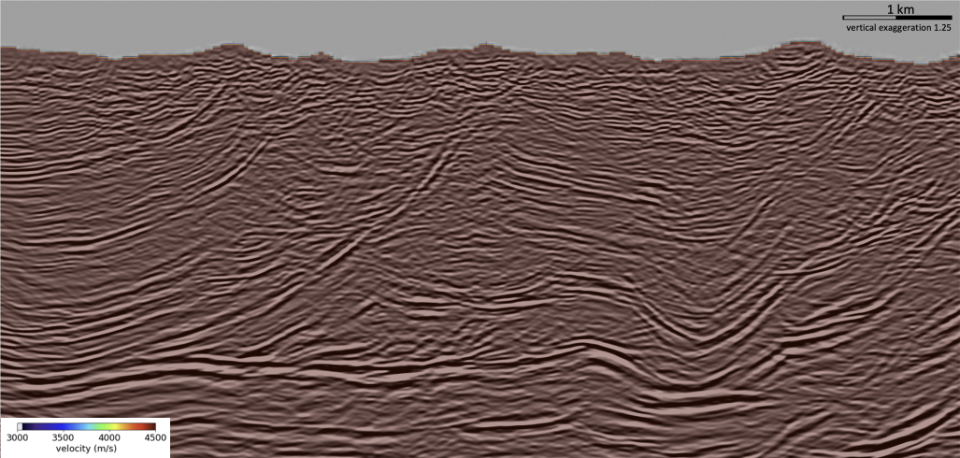
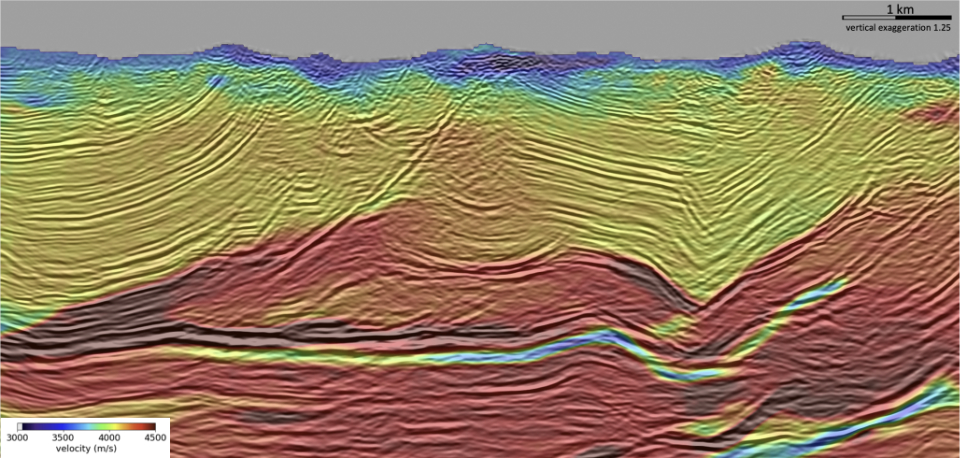
Example of the velocity model predicted by the CNN. The input was a constant velocity of 4500m/s. After 10 iterations of the CNN, the predicted velocity shows a detailed weathering layer, accurate sediment velocities, and a velocity inversion around 2 km below surface due to a shaly coal layer.
Advanced Computational Methods
CNN (Convolutional Neural Networks)
- Applied to identify patterns within seismic datasets.
- Assist in extracting structural and velocity-related information.
- Operate within an interpretive supervision framework.
FWI (Full Waveform Inversion)
- Physics-based inversion methodology.
- Uses full seismic wavefield information.
- Provides high-resolution velocity updates where data quality permits.
Integrated Within the CLIMB Framework
We integrate these methods with our Computer Leveraged Interpretive Model Building (CLIMB) workflow, keeping local domain knowledge at the forefront.
Even when using data-driven methods, the workflow remains highly interpretive. Close client collaboration is key to achieving a geologically consistent and operationally reliable velocity model.
FWI Update Example (Before / After)
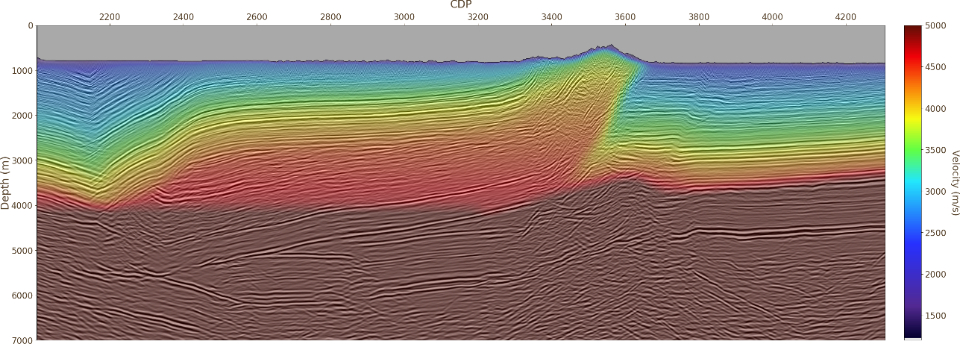
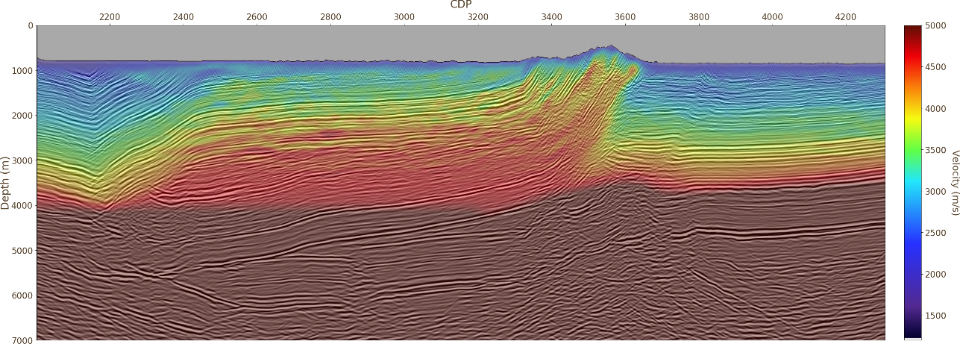
Example of TBI’s land-focused FWI. The input structural velocity model contains the main structural features. The FWI result shows increased model resolution and improved imaging, particularly in the subthrust.